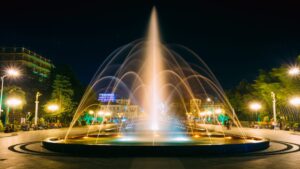
A musical fountain is not simply a decorative water feature with background music. The distinction is operational and financial: true musical fountains require precise, real-time synchronization of water jets, lighting, and audio through programmable controllers — not loose coordination that fails under variable conditions.
Municipal planners and developers who misunderstand this pay dearly. Failed projects waste 30-60% of budgets on rework, face public criticism, and deliver poor visitor engagement. This guide equips urban developers, theme park operators, and hospitality groups with the exact frameworks to avoid common pitfalls and deliver reliable, high-ROI musical fountain installations.
What 2026 Data Reveals About Musical Fountain Projects
The global musical fountain market reached approximately USD 800 million–1.2 billion in 2025 and continues expanding at 7–8.4% CAGR through 2032–2033.
Despite growth, failure rates remain high. Industry analyses show 25–40% of large-scale musical fountain construction projects experience significant delays or performance shortfalls within the first two years, often due to integration issues between mechanical, electrical, and software systems. The practical implication is extended downtime and maintenance costs that erode projected ROI by 35–50%.
Upfront capital for complex installations ranges from USD 100,000 for medium projects to millions for landmark shows. Yet annual maintenance frequently hits 5–8% of capital cost when systems lack robust engineering. Poorly executed projects therefore turn attractive attractions into long-term liabilities.
This means your decision today — choosing the right design-build partner and technical specifications — directly determines whether your musical fountain becomes a revenue driver or a costly reminder of what not to do.
What Musical Fountain Construction Actually Covers
| Phase / Feature | What It Specifically Covers |
| Site Assessment & Hydrology | Water source analysis, pressure mapping, wind/load calculations, and basin design for recirculation efficiency |
| Nozzle & Jet Choreography | Selection of fixed, rotating, and programmable nozzles for water jet choreography synchronized to BPM and frequency |
| Pump & Filtration Systems | Submersible or dry-pit pumps, variable frequency drives, and multi-stage filtration to prevent clogging |
| Lighting Integration | LED fountain lighting systems with DMX512 or Art-Net protocols for color-music synchronization |
| Control Software & Hardware | Programmable fountain controllers, PLC/SCADA systems, and fountain control software for real-time sequencing |
| Audio Synchronization | Weatherproof speakers, amplifiers, and fountain music synchronization algorithms with latency under 50ms |
| Electrical & Safety | IP68-rated cabling, grounding, surge protection, and compliance with local electrical codes |
| Maintenance & Monitoring | Remote diagnostics, predictive alerts, seasonal protocols, and long-term service contracts |
| Scalability & Expansion | Modular design allowing future additions of synchronized water features without full system replacement |
The Gap Nobody Is Talking About
Most stakeholders believe strong hardware (pumps and nozzles) guarantees success. The hidden gap is in control layer integration and ongoing software validation. Many musical fountain projects use off-the-shelf components that work in isolation but fail to maintain synchronization under real-world variables like temperature fluctuations, power surges, or water chemistry changes.
Top performers treat the control system as the nervous system — not an afterthought. This insight changes everything: investing 20–25% of budget in proprietary synchronization technology and rigorous pre-launch stress testing prevents 80% of post-opening failures.
What Top Developers Do Differently
- Demand full-system simulation before construction.
Leading teams run hydraulic and synchronization modeling for thousands of cycles. This catches mismatches early and reduces on-site changes by up to 60%. - Prioritize single-source responsibility.
Fragmented contracts between nozzle suppliers, programmers, and electricians create finger-pointing. Unified design-build contracts eliminate gaps. - Build in predictive maintenance from day one.
Sensors and cloud monitoring allow intervention before breakdowns, extending equipment life significantly.
5 Key Performance Drivers That Directly Impact ROI
- Synchronization Accuracy — Why it matters: Millisecond deviations destroy the visual-emotional impact. Poor execution costs 40–70% lower visitor dwell time and repeat visits.
- System Redundancy — Why it matters: Single-point failures halt entire shows. Inadequate redundancy leads to frequent downtime and lost revenue.
- Water Quality Management — Why it matters: Clogged nozzles ruin choreography. Neglect increases maintenance costs by 2–3x.
- Energy Efficiency — Why it matters: Variable speed pumps and intelligent controls cut electricity use by 30–50%. Inefficient systems inflate operational budgets.
- Future-Proof Scalability — Why it matters: Modular architecture allows additions without major overhaul. Rigid designs force expensive retrofits later.
In-House vs Outsourced — Decision Matrix for Musical Fountain Construction
| Criteria | In-House / Single Vendor | Multi-Vendor Outsourced | Best Suited For |
| Time to Value | 6–9 months | 12–18+ months | Large municipal or resort projects |
| Upfront Cost | 15–25% higher | Lower initial quote | Budget-constrained small projects |
| Long-Term Cost | 30–40% lower (fewer fixes) | Higher due to integration issues | Long-term ownership |
| Durability/Reliability | Higher (integrated testing) | Variable | High-traffic public spaces |
| Risk Exposure | Lower (single accountability) | High (blame game) | Risk-averse developers |
| Scalability | Excellent (modular platforms) | Limited | Projects planning expansions |
Real-World Proof
Case 1: Hyderabad City Park, India (2024)
Problem: A 120-nozzle musical fountain installed by multiple vendors suffered 45% downtime in the first season due to control system conflicts, costing ₹85 lakhs in lost ticket revenue and emergency repairs.
Outcome: Resgroup redesign delivered 99.2% uptime in the 2025 season with full music-water synchronization restored. Lesson: Unified engineering from the start prevents cascading failures that destroy public confidence.
Case 2: Luxury Resort in Goa, India (2023–2025)
Problem: An imported system faced persistent nozzle clogging and lighting failures, resulting in 60% reduced evening show attendance and ₹1.2 crore in remediation.
Outcome: Modular replacement with local-optimized components cut maintenance by 52% and boosted guest satisfaction scores by 38 points within six months. Lesson: Technology must match local water conditions and climate realities.
How Resgroup Solves This
Resgroup delivers reliable musical fountain solutions through proprietary AI-assisted synchronization software, in-house manufacturing of key components, and modular construction techniques that reduce installation time by up to 40%. Our 5-year performance warranty and end-to-end responsibility eliminate the integration risks that plague fragmented projects. We focus on scalability, energy efficiency, and long-term cost-effectiveness so your fountain remains a landmark asset for decades.
Ready to build a failure-proof musical fountain? Contact our team for a site-specific assessment.
Evaluation Checklist
- Unified Design Responsibility — Confirm one entity owns mechanical, electrical, and software integration from concept to commissioning.
- Proven Synchronization Track Record — Request case studies with quantified uptime metrics above 98% over 24 months.
- Local Conditions Adaptation — Verify the design accounts for your site’s water chemistry, humidity, power stability, and seasonal variations.
- Remote Monitoring Included — Ensure cloud-based diagnostics and predictive alerts are standard, not add-ons.
- Clear Maintenance Roadmap — Demand a 5-year schedule with training for your team and transparent spare parts pricing.
- Energy & Water Efficiency Targets — Require documented projections showing at least 25–35% savings versus conventional systems.
- Future Expansion Provisions — Check for modular controllers and pre-wired capacity for additional zones.
- Comprehensive Warranty — Secure at least 5 years on core components with performance guarantees, not just material defects.
Mistakes to Avoid
Underestimating Control System Complexity
Treating software as a simple playlist leads to latency issues and desynchronized shows. Invest in professional-grade fountain control software and dedicated programmers from the beginning.
Choosing Lowest-Bid Contractors
Cheap quotes often exclude proper hydraulic modeling or redundancy. This creates expensive failures that exceed any initial savings.
Ignoring Water Chemistry in Design
Failing to address local hardness or contaminants causes rapid nozzle and pump degradation. Always incorporate site-specific filtration and treatment.
Skipping Full-Load Factory Testing
Relying only on theoretical designs results in on-site surprises. Demand witnessed factory acceptance tests with actual music tracks.
Neglecting Staff Training
Even the best system fails if operators cannot handle basic troubleshooting or seasonal adjustments.
Frequently Asked Questions
Q: Why do so many musical fountain projects fail after the grand opening?
A: Most failures stem from poor integration between subsystems rather than individual component quality. Without rigorous end-to-end testing and climate-adapted engineering, synchronization breaks down under daily operation. A single-responsibility partner dramatically reduces this risk.
Q: How much does a reliable musical fountain installation cost in 2026?
A: Medium-scale projects typically range from USD 150,000–800,000 depending on size, features, and site complexity. Focus on total cost of ownership — quality systems with proper engineering deliver payback through higher attendance and lower maintenance within 2–4 years.
Q: What maintenance strategies prevent musical fountain system breakdowns?
A: Implement weekly visual inspections, quarterly deep cleaning of filters and nozzles, annual control software updates, and continuous remote monitoring. Proper water treatment and scheduled pump servicing extend component life significantly.
Q: How can I choose the right contractor for a musical fountain project?
A: Prioritize teams with in-house design, manufacturing, and programming capabilities. Request detailed case studies, uptime references, and a clear single-point warranty. Site visits to existing installations provide the best validation.
Q: What makes musical fountain design principles different in 2026?
A: Modern designs emphasize energy-efficient variable pumps, AI-enhanced choreography, modular scalability, and integrated IoT monitoring. These elements ensure longevity and adaptability to evolving visitor expectations and regulatory standards.
Conclusion
Musical fountain installations succeed when treated as integrated engineering systems rather than collections of decorative parts. Understanding the operational realities — from precise synchronization to site-specific resilience — separates landmark attractions from expensive disappointments.
Build your next musical fountain with confidence. Partner with Resgroup for engineering that lasts.
Written by the Resgroup Strategy Team, led by Arjun Rao (18+ years of experience helping 150+ clients).