Urban infrastructure in India is changing rapidly. As smart city development accelerates, public spaces now focus equally on sustainability, aesthetics, and visitor engagement. Consequently, modern water features have become essential elements in urban planning. Today, Fountain construction services in kolkata play a significant role in transforming commercial hubs, public parks, hotels, residential complexes, and government projects into visually interactive environments.
According to the Ministry of Housing and Urban Affairs, India’s Smart Cities Mission has already completed thousands of urban development projects across transportation, landscaping, public utilities, and recreational infrastructure. As a result, architects and developers increasingly integrate advanced fountains into landscape master plans to improve public interaction and environmental appeal.
Modern fountain systems now combine digital automation, LED illumination, recycled water circulation, and interactive designs. Therefore, property developers increasingly rely on professional fountain construction services to create sustainable and technologically advanced installations suitable for smart urban environments.
Why Are Smart City Projects Investing in Modern Fountain Infrastructure?
Smart city projects prioritize urban livability. Consequently, decorative and interactive water features have become valuable components of public infrastructure.
According to the Smart Cities Mission Dashboard, India has invested heavily in public space beautification, pedestrian-friendly landscapes, and recreational urban zones. Modern fountains support these goals by improving visual identity and encouraging community engagement.
Key Reasons Behind Rising Demand
| Urban Development Need | Role of Modern Fountains |
|---|---|
| Public engagement | Creates interactive gathering spaces |
| Landscape enhancement | Improves architectural aesthetics |
| Heat reduction | Supports microclimate cooling |
| Tourism appeal | Attracts visitors and increases footfall |
| Smart infrastructure | Integrates automation and IoT controls |
In Kolkata, this trend is highly visible across luxury hotels, township projects, IT parks, shopping malls, and riverfront developments.
How Is Kolkata Adapting to Smart Fountain Technology?
Kolkata’s urban landscape is evolving quickly. Several redevelopment projects now emphasize experiential outdoor environments rather than basic landscaping.
Moreover, developers increasingly integrate:
- Programmable musical fountains
- Interactive pedestrian fountains
- Digital water curtains
- LED synchronized water displays
- Sustainable recirculation systems
- Motion-controlled water features
These technologies improve operational efficiency while creating visually immersive public environments.
Smart Automation Is Reshaping Fountain Engineering
Modern fountains no longer depend on manual operation. Instead, automated systems optimize water pressure, lighting synchronization, and filtration performance through centralized digital controls.
For example, IoT-enabled fountain systems can:
- Monitor pump efficiency in real time
- Adjust lighting automatically
- Detect water level variations
- Reduce energy wastage
- Schedule maintenance alerts
As a result, urban authorities achieve better operational management while maintaining long-term sustainability.
What Types of Fountain Systems Are Trending in Kolkata?
Different urban projects require different fountain solutions. Therefore, customization has become essential in modern landscape engineering.
Musical Fountain Installations
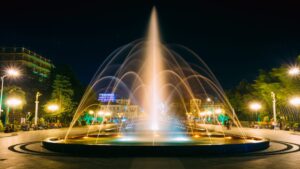
Musical fountains combine synchronized water movement, sound systems, and dynamic lighting effects. These installations are highly popular in:
- Public plazas
- Tourism destinations
- Hospitality projects
- Government recreational parks
According to India’s urban tourism reports, experiential public attractions significantly improve visitor retention in commercial and civic spaces.
Interactive Dry Deck Fountains
Dry deck fountains allow pedestrians to walk safely through water jets integrated into paved surfaces. These installations are increasingly used in:
- Smart parks
- Shopping districts
- Residential townships
- Mixed-use developments
Additionally, these systems maximize space efficiency because they eliminate exposed water basins.
Architectural Water Walls
Vertical water walls are gaining popularity in premium commercial projects due to their modern appearance and low spatial requirements.
Common applications include:
| Application Area | Functional Advantage |
|---|---|
| Hotel lobbies | Luxury visual experience |
| Corporate offices | Ambient sound control |
| Retail environments | Visitor engagement |
| Rooftop landscapes | Space optimization |
Consequently, many architects now prioritize water walls in compact urban developments.
Why Is Sustainability Important in Modern Fountain Design?
Environmental sustainability has become central to smart city planning. Therefore, modern fountain engineering focuses heavily on resource efficiency.
According to the Central Public Health and Environmental Engineering Organisation (CPHEEO), urban water management systems increasingly require sustainable circulation and recycling technologies.
You can learn more about India’s urban infrastructure initiatives through the official Smart Cities Mission portal.
Sustainable Features Commonly Used Today
Water Recycling Systems
Most modern fountains reuse filtered water continuously. Consequently, water consumption remains significantly lower compared to traditional systems.
Energy-Efficient LED Lighting
LED underwater lighting consumes less electricity while delivering advanced programmable illumination effects.
Smart Pump Technology
Variable-frequency drive pumps automatically optimize energy usage depending on fountain activity.
Eco-Friendly Filtration
Modern filtration systems reduce chemical dependency while improving water clarity and hygiene.
As sustainability regulations tighten, these technologies will likely become standard requirements in future projects.
How Do Fountain Installations Improve Real Estate Value?
Modern water features strongly influence buyer perception and visitor experience. Therefore, developers increasingly consider fountains strategic branding assets rather than decorative additions.
According to Indian real estate trend analyses, experiential amenities improve both commercial engagement and residential desirability.
Benefits for Real Estate Projects
- Enhances project identity
- Creates premium landscape appeal
- Improves visitor retention
- Supports social media visibility
- Strengthens community interaction
- Increases recreational value
For example, integrated landscape fountains in mixed-use developments often become focal points for public interaction and photography.
What Technical Factors Determine Fountain Project Success?
Successful fountain engineering depends on both aesthetics and infrastructure planning. Therefore, experienced design teams conduct detailed site evaluations before execution.
Critical Planning Considerations
Water Pressure and Hydraulic Design
Improper hydraulic balancing affects jet consistency and overall performance.
Electrical and Safety Integration
Modern fountains require safe integration of:
- LED systems
- Control panels
- Automation units
- Underground cabling
Drainage Management
Poor drainage planning may cause water overflow or surface damage in public spaces.
Weather Resistance
Outdoor fountain systems must withstand:
| Environmental Factor | Required Protection |
|---|---|
| Heavy rainfall | Waterproof electrical systems |
| Dust exposure | Sealed control units |
| Humidity | Corrosion-resistant materials |
| Temperature fluctuation | Durable piping systems |
Therefore, professional planning significantly improves operational durability.
How Are Smart Cities Using Interactive Water Features?
Interactive water features are increasingly important in urban engagement strategies.
Unlike traditional static fountains, interactive installations encourage public participation through responsive lighting, synchronized jets, and digital controls.
Common Smart City Applications
- Public entertainment zones
- Urban recreation parks
- Riverfront developments
- Transit-oriented developments
- Tourism enhancement projects
Additionally, these systems often support cultural programming and public events.
For example, musical fountain shows during festivals and civic celebrations now attract substantial public participation across Indian metropolitan cities.
Why Is Location-Specific Design Important in Kolkata?
Kolkata’s environmental conditions require specialized engineering considerations.
Climate Challenges Affecting Fountain Projects
High Humidity
High moisture levels increase the risk of corrosion in electrical and metallic components.
Monsoon Rainfall
Heavy rainfall demands advanced drainage and waterproofing systems.
Urban Pollution
Dust and pollutants require efficient filtration and regular maintenance planning.
Therefore, location-specific engineering improves both performance and longevity.
How Are Commercial Spaces Benefiting from Advanced Fountain Design?
Commercial environments increasingly use water features to improve customer experience and strengthen architectural identity.
High-Impact Commercial Applications
| Commercial Space | Fountain Benefit |
|---|---|
| Shopping malls | Increased visitor engagement |
| Hotels | Luxury branding enhancement |
| IT parks | Relaxation-oriented environments |
| Restaurants | Ambient outdoor experience |
| Event venues | Visual attraction |
Consequently, commercial developers now integrate fountain systems during the early landscape planning stage rather than treating them as secondary additions.
What Should Developers Look for Before Starting a Fountain Project?
Before execution, developers should evaluate technical expertise, sustainability practices, and long-term maintenance capabilities.
Essential Evaluation Checklist
- Experience with smart automation systems
- Knowledge of hydraulic engineering
- LED lighting integration expertise
- Waterproof electrical safety compliance
- Sustainable water circulation planning
- Structural coordination capabilities
Additionally, project teams should ensure compatibility with surrounding landscape architecture and urban infrastructure.
Future Trends Shaping Fountain Construction in Kolkata
The future of smart urban landscapes will likely depend heavily on interactive and sustainable water infrastructure.
Emerging Trends to Watch
AI-Based Fountain Automation
Artificial intelligence may soon optimize water flow and energy efficiency automatically.
Sensor-Driven Interactive Fountains
Motion-responsive water features are expected to expand in public recreation zones.
Solar-Powered Fountain Systems
Renewable energy integration will support greener urban infrastructure.
Digital Projection Water Shows
Advanced projection mapping technology may create immersive public entertainment experiences.
As Kolkata continues developing smart urban infrastructure, these innovations will likely influence future landscape architecture significantly.
Conclusion
Modern urban infrastructure now demands more than functional design alone. Smart city development increasingly prioritizes sustainability, public engagement, and visual identity. Consequently, Fountain construction services in kolkata are becoming central to contemporary landscape planning across commercial, residential, hospitality, and public sector projects.
Today’s advanced water features combine automation, sustainability, architectural integration, and interactive technology to create meaningful urban experiences. As smart infrastructure projects continue expanding across India, fountain systems will likely play a larger role in shaping modern public environments.
Developers, architects, and urban planners who invest in future-ready water feature engineering can significantly improve project appeal, environmental efficiency, and long-term user engagement.
FAQs
1. What are the most popular fountain types used in Kolkata smart city projects?
Musical fountains, dry deck interactive fountains, water walls, and LED-integrated digital fountains are currently the most widely used systems in urban development projects.
2. Why are automated fountain systems becoming popular in commercial projects?
Automated systems improve operational efficiency, reduce energy usage, simplify maintenance, and enable synchronized lighting and water control.
3. How do modern fountains support sustainable urban infrastructure?
Modern systems use recycled water circulation, energy-efficient pumps, LED lighting, and smart monitoring technologies to reduce environmental impact.
4. What factors affect the durability of outdoor fountain systems in Kolkata?
Humidity, rainfall, pollution exposure, waterproofing quality, drainage planning, and corrosion-resistant materials strongly influence long-term performance.
5. Are interactive fountains suitable for residential townships?
Yes. Interactive fountains improve recreational value, enhance landscape aesthetics, and create engaging communal spaces within residential developments.